Some of the most talked-about films of 2026 are rooted in YouTube, not Hollywood.
The path from YouTube creator to professional filmmaker was once considered unusual. Now, it is becoming increasingly common. Studios, festivals, and audiences are paying attention to creators who learned to tell stories on their own.
In Central Arkansas, a generation of young filmmakers is part of it.
Twenty-two-year-old Cameron James makes comedy videos and short films from his home here in Little Rock. He never enrolled in film school, but he’s been uploading to his YouTube channel since high school, when a film elective first made him take the idea seriously.
“I had always loved movies and wondered about making them. But it wasn’t until I took that class that I seriously started considering pursuing a career in filmmaking.”
James and a friend came up with the name Mongolian Film Collective as a joke during that class. Today, the YouTube channel features everything from whacky comedy videos to a 40-minute drama about the end of a relationship.
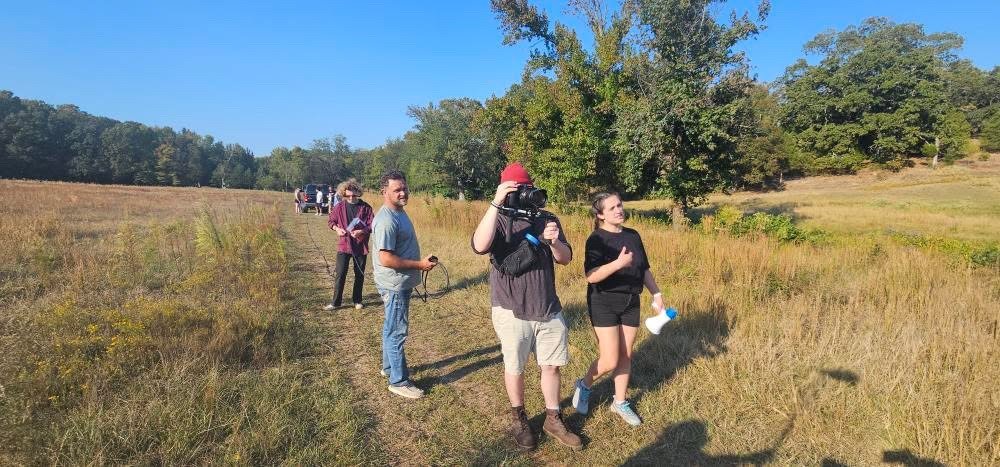
He does it all with minimal gear: a camera, a microphone, and a boom pole made from a broomstick. And most importantly, a group of friends; his troupe of actors.
“Arkansas is well outside of the film industry. Being completely independent has made me more determined to get my stuff out there and seen by as many people as possible.”
Jacob McKellar’s story starts in the same place — YouTube. The twenty-three-year-old traces his love of the craft back to watching a creator called stampylongnose as a kid, the same kind of bedroom-produced content that hooked an entire generation. He eventually enrolled in the film program at the University of Central Arkansas. But, he says it was those early online influences that first made him want to pick up a camera.
“I had no idea there were so many people in Arkansas that are interested in making films. I’ve gotten to work a lot with others through my enrollment.”
McKellar has worked on several student film sets, including as cinematographer on Hollow House, directed by classmate Brianna Lewis. He says the experience has been a reality check about just how demanding the industry is.
“You could spend up to 15 hours a day on an industry film set, which can be just exhausting. It can feel hard to push myself to keep pursuing it, especially since the work might not get noticed coming out of Arkansas.”
McKellar recently worked on an upcoming feature film being shot here in the state. But despite that opportunity, he’s candid about what he sees ahead.
“It’s difficult to admit, but I think it will be necessary to leave Arkansas to advance as a filmmaker. There are just more opportunities elsewhere.”
That sentiment is shared by Adrian Rogers, a Mass Communications student at the University of Arkansas at Little Rock. Rogers went the extra mile, literally, studying film abroad last summer at Griffith Film School in Brisbane, Australia. That experience, he says, helped him land local opportunities, including work on that same Arkansas feature film.
Rogers is also building his profile closer to home, through an Instagram video series called Goo News. He says social media has become the real frontier for independent filmmaking. And, he wants his work where audiences already are.
“Social media is where a lot of innovation in filmmaking is happening. If I tell people to watch my comedy videos on YouTube, they will agree to and forget about it. When I give people an Instagram page to follow, they are more likely to check it out.”

The larger industry is paying attention.
Filmmakers like Satvik Soni have parlayed cinematic social media work into festival-selected short films, a path Rogers says he’s watching closely.
“In making my own videos, I am the writer, producer, cinematographer, editor, and director. This is great because it has expanded my skills, but I want to have more resources eventually.”
McKellar says he’d like to see Arkansas build more of those resources. More film programs, more academic encouragement, and feature-length courses where students can work on full productions together.
But for those working without any of that, James has simpler advice.
“I tell everyone that if they want to do it, they just need to get out and do it. If you love to do it, you should try regardless of what success comes initially.”
McKellar agrees, and says, he sees something larger at stake.
“Just be yourself and make art. The amount of access this generation has to filmmaking resources ensures that our contributions will be more unique than any made before us.”
Sources
Chart data: eMarketer. Photo by Seth McCullough.